Sunday, January 6, 2013

1. Game of Thrones by George R.R. Martin

Counting this as the first book I read this year is a bit like cheating; it would be more appropriate to call it the first book I finished this year, since I started it in August, read some in October, and read most of it before the year turned. But whatever — it's still the first of the year.

Anyway, this post will likely contain spoilers from the two seasons of Game of Thrones that have aired on HBO, but nothing beyond that (since obviously I haven't read those books yet). So if you haven't watched/read yet, stop and do that, because it's really quite good.

One of the things that most impressed me when I was reading the book is how close the TV series sticks to the novel. There are some changes that people like to complain about — and maybe I would too, if I'd read the books first — but nothing that was a game changer, for me. Though I was kind of annoyed that when I bought the paperback at Target, they only had the HBO cover (I hate movie/tv show covers, on principle). As far as book covers with TV art on them go, it's actually kind of cool, so I'll live.

But of all the complicated humans in the world of A Song of Ice and Fire, I'd like to look at just one — the often misunderstood Sansa Stark.

The most common criticism of Sansa is that she's obsessed with herself (and her future position as queen), is immature and disloyal to her family. That all, frankly, is crap. Sansa Stark is a young girl who her whole life has been taught to be a lady and rule the house of whoever she should marry. She's told stories of love and knights and magic. She's told to marry the prince and that he's the greatest guy ever. Her annoying sister — who's the opposite of everything she wants to be — tries to ruin her fairytale come true. Really, she's just naïve.

When things hit the fan, she tries to save her family. She doesn't know not to trust Cersei, she thinks she's saved her father's life. Like I said, naïve. It's about putting things back the way they were, trying to keep her family from destruction. She still doesn't realize what a horrible human Joffrey is.

And then, well, she does. And she becomes the Lannister's hostage, Joffrey's plaything.

So yeah, Sansa isn't her sister, Arya. She doesn't like sword fights or running or being dirty. She believes the patriarchy she's been fed all her life, and then she realizes it's all a lie. I don't fault her for that.

Friday, January 4, 2013

26. This Is How You Lose Her by Junot Diaz (and an update)

Happy New Year kids. Obviously, this got derailed in the fall semester. Basically, after number 25 I started reading Game of Thrones, and then things became pretty crazy and my resolution was pushed to the wayside.

But now I'm going to try again. With the book I'll talk about in a second, which I read over Thanksgiving, I read 26 books — exactly half my goal — in 2012. So, I think I can hit 52 in 2013. At the very least, we'll see. I'll probably (finally) finish "Game of Thrones" by tomorrow, so that'll be the first book of the new year. But here are some thoughts on the last book I read, not for school, in 2012:


Before I picked up this book, I read this awesome interview Junot Diaz did to promote it (you may remember my love affair with Junot from last January, when I read his first short-story collection, Drowned). Anyway, if you read that interview, you'll understand why I think he's the bees knees. Par example:

"I have so many young writers who're like, 'Well I was inspired. This was my story.' And I'm like, 'OK. Sir, your inspiration for your stories is like every other male's inspiration for their stories: that the female is only in there to provide sexual service.'"


Famous male writer talking about male privilege? Sign me up.


Anyway, this book was super short (and it was a short story collection), so it was easy to get through, but it was also incredibly well-written and generally amazing. Most of the stories focus on Yunior (who was a character in The Brief Wondrous Life of Oscar Wao), who's a womanizing jerk, despite his generally good heart. 


I don't actually have anything else to say, awkwardly, except that it's really well-written and heart-breaking and wondrous, just like Junot's work always is. What a good writer. I only wish it was longer.


So that's it amigos. Hit me up with your book suggestions.

Friday, August 17, 2012

25. Everything Ravaged, Everything Burned by Wells Tower

Man, I love short story collections. I wonder — have I read what seems like so many since January because they're trendy right now, or have they always been this popular? Or, do more of them just happen to be really well-written? No idea.

I did appreciate that Tower bucked one trend at least; lots of other collections link the stories and characters together in small or large ways. This one is that one's granddaughter or co-worker or the person they hit with their car. I really enjoyed those, but it's not the route Tower chooses (though, I kind of was hoping that the last story would link them all together. It didn't).

What does link the stories together is pain, loneliness, divorce (almost all of them had at least on divorced character), and humanity. They were little snapshots of people really screwing things up, and it was pretty awesome.

My favorite story was about a kind of homely teenage girl, Jacey, whose glamorous, ballerina cousin visits and makes her feel childish and dumb and undesirable. She tries to make herself feel better, but only makes herself feel worse. Been there, done that. 

The book is about older men with unresolved issues, sons and daughters dealing with selfish parents and stepparents, and husbands and wives just trying to find happiness. Also the last story is about Vikings, which is really random but also cool. Something for everyone, I guess.

Anyway, I recommend it. It's a really fascinating look at human relationships.

Tuesday, August 14, 2012

24. The Grapes of Wrath by John Steinbeck

Shockingly not about angry grapes. Who knew?
Did ya miss me?

I made the same poor decision in my speed reading quest -- I picked a very long book to read. But once again, it was worth it.

I faced the same problem when I read Steinbeck's other epic tome, East of Eden. Both are amazing, but in spite of how much I enjoyed them, they took forever to finish.

But The Grapes of Wrath was worth it, even if I've fallen hopelessly behind in my quest (though, to be fair, "Game of Thrones" and "Doctor Who" are to blame as well. Also tumblr).

The novel is about farmers who are kicked off of their Midwest land during the Great Depression and head west in search of a better life. It's obvious from the beginning that things won't turn out well for the Joads, but you end up hoping for things to turn around in spite of this.

Besides having some great characters and exchanges, The Grapes of Wrath also has some important political messages about the destruction of the small farmer and the abuse of labor. And, while it would be easy to close this book and say "That's all in the past," migrant farmers still live in America, enduring horrible conditions in search of a better life. The difference is that now instead of calling white people from the Midwest "Okies" and starving them, we do it to people from other countries who we call "aliens." Ugh. I'm not even trying to make a political statement about immigration -- I'm just saying that the people who pick our fruits and vegetables should make a living wage. I mean, all people in America and around the world should. I think that Steinbeck would agree.

Part of the point of the book is how you need family to help you -- or a replacement family. You need someone you love because, as Tom Joad says, quoting his friend the preacher Casy, when you have two people one can lean on the other when the going gets rough.

But in Hoover-era California, these bonds fall apart. People are wrenched from each other and have to find new ways to survive. It's unclear that they will. Good job bumming me out, John.

I feel similarly to how I did when I read Angela's Ashes -- how did people survive this? Obviously people did. I'm in awe of the human condition.

Sunday, July 15, 2012

23. The Great Gatsby by F. Scott Fitzgerald

There were three main reasons why I wanted to reread this book, which I read for the first time during my junior year of high school:


  1. It's probably one of my favorite stories ever.
  2. It was discussed extensively in Reading Lolita in Tehran.
  3. I saw the trailer for the movie.
Actually, I just rewatched the trailer, and I'd have to say that — from that trailer alone — it seems like they did a pretty great job capturing the spirit of West Egg. The one negative comment I have is that Tom Buchanan should have been portrayed by Georgetown alum and total hawt guyy Bradley Cooper, who said he wanted to role. Think about it. Bradley Cooper is what I always picture Tom would be like.

Before I go further, let me say that if you haven't read this book yet, immediately stop reading this blog and find yourself a copy. Then don't do anything until you're done and then you can come back to this post. Everyone good now?

I think I want a new copy of Gatsby. As evidenced by the scribblings I put in many amazing books, my high school teachers were a little obsessed with "active reading." The idea was that you marked up your book, writing questions, considering themes. I like to think that I always actively read — I just don't destroy my books —, but in high school my teachers would do "Active Reading Checks" and flip through our books to make sure we'd written some things down. As a belligerently active reader, lots of my insightful comments on the text are literally just "haha," "that's messed up," "SEXISM," or inane repetitions of what was just said.

In general, I would underline anything I found profound or particularly well written. In many books, that was only a few sentences a chapter. In Gatsby, it's half the book. So reading my four-year-old copy was miserable, because the highlights and comments were so distracting. Duh, Tom is a sexist prick. Duh, some passages are confusing. If I were ever an English teacher, I'd only let students active read in bad books they'd never want to read again, not wonderful ones like The Great Gatsby.

Anyway, this time around, I was struck by how much Nick Carraway, the narrator (but arguably not the main character), sounds like he could have been a JD Sallinger narrator — or I guess how much Sallinger is like Fitzgerald.

Gatsby and Sallinger's works are obsessed with the phony, rich people of New York, outwardly beautiful and inwardly miserable. They hate it, and yet they're obsessed with it.

Fitzgerald is probably one of the greatest American writers ever. Even if he'd just written this one book.  One of the things that amazes me about Gatsby is that it's so short, but so rich — I think Fitzgerald has an ability to lean into silences, to leave enough threads that the reader can pick up on things he's not saying aloud. And that's how he can write the quintessential American story in 180 pages, while it took John Steinbeck 601 to write East of Eden. (Currently reading Steinbeck's Grapes of Wrath by the way). Of course, East of Eden is a wildly different book, an amazing epic, but it seems easier to write the great American story in a giant volume than a small one.

This time, whilst reading the book, I had to wonder what's so special about Daisy that Gatsby is so obsessed with her. She's a pretty, flirty rich girl, vain and uninteresting. For all you could say about Jay Gatsby, you can't say he's vain or uninteresting.

When Gatsby is reunited with Daisy, he says to Nick that she's changed, and I suppose that accounts  for some of it — people do change, and it's obvious that Daisy was wracked by Gatsby-related heartache. But I think it's mostly explained by time and the mind. The books ends with: "And so we beat on, boats against the current, borne back ceaselessly into the past." Nostalgia is powerful, the past is powerful, and Gatsby became attached to a summer love. What he wanted when he was 19 was no longer what he wanted when he was 30. That's real life, but it's not something you expect, especially when you've been chasing that thing ever since you first set eyes on it.

But at the end, Daisy wasn't worth it — "'They're a rotten crowd,' I shouted across the lawn. 'You're worth the whole damn bunch put together.'" And Gatsby dies for a dream based on nothing. Man.

I'm going to stop now, but could literally continue for an hour. If you have Gatsby thoughts, leave a comment or shoot me an email. And I'll leave you with a quote, my favorite from the book, on Gatsby's smile. Can we just consider how beautiful these words are?


"It was one of those rare smiles with a quality of eternal reassurance in it, that you may come across four or five times in life. It faced — or seemed to face — the whole external world for an instant, and then concentrated on you with an irresistible prejudice in your favor. It understood you just as you wanted to be understood, believed in you as you would like to believe in yourself, and assured you that it had precisely the impression of you that, at your best, you hoped to convey."

Tuesday, July 10, 2012

22. Angela's Ashes by Frank McCourt

Here's another book that has been sitting on my shelf forever and I never read. I have no idea what possessed me to finally pick it up last week, but I did. You should probably listen to this song while you read this post. Or this one — but the other one is definitely more relevant.

I'm not Irish, but growing up I always wanted to be because most of the kids in my Catholic elementary school were. On St. Patrick's day they'd come in with green stickers, shamrock pins, Irish sweaters, and Erin Go Bragh hats. St. Joseph's Day was the closest Italian equivalent, and — though we got delicious pastries — the two days certainly can't be compared. Also, I think freckles and red hair are beautiful, which I think played a roll.

But I can't say that I contemplated seriously about the history of Ireland until my senior year of high school, and even then, it was only because of a passing comment my teacher made — she said that the British taxes on grain could have been considered genocidal, since the Irish were dealing with the potato famine.

Actually, I take that back — junior year I read Jonathan Swift's "A Modest Proposal" in an English class, so I guess I'd thought about it a little bit then too. But Ireland often seems like a historical footnote, the Irish constantly looked down upon by the English/British, struggling to survive.

In this memoir, Frank McCourt recounts his childhood; his parents both moved from Ireland to New York, met, procreated, got married. His father's an alcoholic, squandering his money and making his boys promise to die for Ireland. When his infant sister dies, Frank's parents move him and his three brothers back to Ireland.

There's lots of suffering to go around, but the depressing existence Frank endured is lightened by the childish humor he brings to the text. One year in school he must imagine what'd have happened if Jesus had been born in his city, and he concludes that it's a good thing He was born Jewish instead because in Ireland he'd have died of consumption and there'd be no Catholics.

Another great moment is also influenced by his school teachers, who constantly try to convince the boys that they ought to be willing to die for their faith:


"The master says it's a glorious thing to die for the Faith and Dad says it's a glorious thing to die for Ireland and I wonder if there's anyone in the world who wants us to live."

In Frank's Ireland, everyone is obsessed with death — what you're dying for, if anything. Your relatives who are constantly dying, from old women to small babies. Young Frank can't help but wonder why.

Frank also deals with Catholic guilt, which Jack Donaghy describes much more eloquently than I could... But it's both humorous and sad how so many people in Frank's life use religion as a means — a way to get kids to behave, to make money at your First Communion so you can go to the cinema. At the age of 10, Frank is hospitalized with typhoid fever and is punished by a nun in the hospital for talking to a girl in the room next door. God doesn't like platonic fraternization of 10 year-olds apparently — too much temptation...

Since it's a memoir, the book doesn't have a climax or anything; the miseries just pile unto each other until the book ends. And while it's an upsetting book to read — it's upsetting to read about any suffering, I think, especially suffering that actually happened/continues to go on today, though in different corners of the globe —, it was also extremely enjoyable.

Wednesday, June 27, 2012

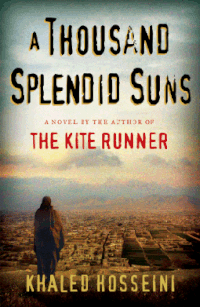
21. A Thousand Splendid Suns by Khaled Hosseini


Yesterday I read a New York Times editorial in which a middle school teacher, Claire Needel Hollander, discussed summer reading. She said how she usually told parents that "Any reading is good reading" but that this wasn't true. Sh e argued that while the poorest readers could gain skills from anything, more advanced readers didn't have that much to gain from The Hunger Games: 


"While “The Hunger Games” may entrance readers, what does a 13-year-old gain in verbal and world knowledge from the series? A student may encounter a handful of unfamiliar words, while contemplating human dynamics that are cartoonish, with violent revolution serving as the backdrop for teen romance."


And well, I just have to disagree. I mean, she's correct with regards to the vocabulary, but the plot? Pshh. I'm still thinking about it months later. Anyway there's this one line that seems particularly relevant. Before Katniss and Peeta enter the arena, he says to her that night:

"I just keep wishing I could think of a way to show them that they don't own me. If I'm gonna die, I wanna still be me."


Isn't that the quintessential human struggle, especially under the pressures of totalitarianism and tyranny? It's what Winston and Julia struggled for in Nineteen Eighty-Four, it's was the reason why the book club was started in Reading Lolita in Tehran, it's what Lenny and Eunice try for in a destroyed American in Super Sad True Love Story. And, it's what gives Laila and Mariam (and other characters) strength in A Thousand Splendid Suns in the face of the tyrants they encounter — the Soviets, the Mujahideen, the Taliban, their husbands.


Each woman clings to herself and each other in order to survive, in order to retain their humanity and dignity in the midst of a society that wants to make them literally inconsequential.


I bought this book two years ago, and I know I started it at least once before, but it never stuck. I guess I didn't like it. That amazes me in retrospect because I loved this book. I'm in awe of it — its beautiful words and characters, its tragic wonder.


But I hate the cover.

Friday, June 22, 2012

20. Confessions of an Ugly Stepsister by Gregory Maguire

I was very hesitant about reading this book because I didn't like his best known book, Wicked, which was the inspiration for the musical of the same name. That book was weird -- political, sexual, magical. I honestly think the fluffy musical is a drastic improvement on that plot.

But Confessions of an Ugly Stepsister was extremely enjoyable (I'm going to assume that you're probably not going to read it, so light spoilers lie ahead).

The central conceit of the plot is that it's the truth behind the Cinderella story -- a story that was warped by rumors and children's imagination into the beloved fairytale.

Iris and Ruth, the ugly stepsisters, are half British and half Dutch. Their Dutch mother brings them back to the village she grew up in after disaster strikes their family abroad, and then she wheedles their way into some higher positions. She sucks.

Clara is Cinderella, the most beautiful girl in the village who rarely leaves her house after some childhood trauma. She's spoiled and aloof, and eventually just depressed. But she and her stepsisters have a strange bond that borders on love.

But Iris is the focus of the book, including Iris's dealing with unrequited love. Obviously I've never written about that before, and I couldn't identify with that plot at all. #storyofmylife


Iris is super plain looking. It's mentioned about every other chapter, which gets a little old. But the whole unrequited thing is done pretty well.


Anyway, I'd like to talk about something that's in this book but isn't specific to it -- a "Reader's Group Guide." It seems that all contemporary, popular novels have one, and I hate them. It's like the English teacher you hated in sixth grade came up with the dumbest, most obvious questions possible (but, to be honest, I loved all my middle school English teachers). But really? "What lesson can be learned from the story?" ARE WE FIVE? Do real people have real book discussion where they ask these obnoxious questions? "Do you think her beauty is a curse or a blessing?" Yawn. 


My friends and I tried to have a book club (which failed) but I'm sure we wouldn't have talked about anything that stupid. Probably would have done something more like this


But really, who are these people who look at these guides because they don't know what else to discuss? Do they actually start invigorating conversations? Probably not. I'd much rather talk about my feelings about the book -- but I always want to talk about my feelings. I guess other people would rather be less personal in their literary discussions, but I think that was part of the point of Reading Lolita in Tehran -- literature, especially that of any worth, is going to be personal. Also, that whole lesson question really got on my nerves. Stories don't need to have lessons, even ones based on fairy tales. Then they're just moral tracts. I love moral ambiguity (have you noticed?), and this book was full of it.


So let's all boycott "Reading Group Guides." Cool? Cool.


Next up: Maybe Grapes of Wrath? Or Jane Eyre. Or The Great Gatsby. Hrmph.

Tuesday, June 19, 2012

19. Nine Stories by JD Salinger

Maybe after my last post, you expected me to read The Great Gatsby. Nope. Instead I read this short story collection that I've been dying to get my hands on.

When I read The Catcher in the Rye, I honestly hated it. I remember going to school the next day and complaining to my English teacher that I didn't get the point. He asked if everything had to have a point, and I said no, but I expected that a book that everyone else liked so much would have a point.

Then, one of my friends told me to read Franny and Zooey, which is actually two shorts stories, "Franny" and Zooey." I bought the book, but then I think it languished on my shelf for a good two years. Then one day I picked it up and loved it. Franny and Zooey are members of the Glass family -- a cast of characters that appear throughout Salinger's works. I eventually read Raise High the Roofbeams Carpenters and Seymour: an Introduction last summer, two more stories about the Glass family. This book was the missing piece.

Only two stories are about Glass family members, but in "Seymour: a Introduction" another Glass -- Buddy -- takes credit for two more of the stories.

Salinger's stories are usually about rich, young people from the Upper East Side of Manhattan, and I love them all so much. They're all ambiguous, unhappy and unresolved (I just realized that the antecedent of that pronoun is unclear, but the sentence works with both the stories and the characters being represented by "they," so I'm leaving it).

They're all random and frivolous -- stories of unhappy girls who drown their sorrows in booze, men who were messed up by "the war" -- be it WWII or Korea and children much smarter and sadder than they should be. It's real life. It's awesome.

If I ever wrote a book I'd want to be like Salinger and write messy characters who make bad, irrational decisions. I'd write stories whose endings were unclear, where ramblings were not only allowed but encouraged and women are just as useful as men (Salinger likes female characters, which makes me happy).

"The fact is always obvious much too late, but the most singular difference between happiness and joy is that happiness is a solid and joy a liquid."

Sunday, June 17, 2012

18. Reading Lolita in Tehran by Azar Nafisi

Lately, I've wondered if I should reread The Great Gatsby. I'd count it as one of my favorite books, but I've only read it once, practically four years ago. After reading this book, I know I have to.

Nafisi talks about Gatsby in her memoir, saying, "I told them this novel" -- Gatsby -- "was an American classic, in many ways the quintessential American novel. There were other contenders: The Adventures of Huckleberry Finn, Moby-Dick, The Scarlet Letter. Some cite its subject matter, the American dream, to justify this distinction. We in ancient countries have our past -- we obsess over the past. They, the American, have a dream: they feel nostalgia about the promise of the future."

I was just startled to read such a pertinent description of America.

But, it would be a disservice to the book if I just talked about America. That's not the point of the memoir, though America's presence plays a role in the lives of Nafisi, her students, and --arguably -- the whole Iranian people.

The book tells of Nafisi's time in Tehran. She teaches at the University of Tehran before the revolution. She briefly quits, refusing to teach with a mandatory veil, but decides to become a professor again. She eventually resigns for a final time, but not before hand-selecting a few students for a private class in her home, where they read the forbidden books: Lolita, Jane Austen.

The memoir's stars are not just the women and men whose lives combine to give a complex portrait of Iran, but the novels they read shine as well. Somewhere around the middle Nafisi apologizes, blaming the extensive amounts of time she'd spent writing critical articles as the reason why she sometimes launches into extensive analysis of the books. But I think a quote on the very first page colors the whole book: "Do not, under any circumstances, belittle a work of fiction by trying to turn it into a carbon copy of real life what we search for in fiction is not so much reality but the epiphany of truth." It's such a true statement, getting at a temptation I've definitely felt, and a temptation Nafisi flirts with but successfully avoids.

It seems a strange coincidence that I picked this book up right after reading Nineteen Eighty-Four. It wasn't premeditated, but the two books played off each other in great (by which I mean horrid) ways -- Nafisi even mentions Orwell's book in her first few pages.

The Islamic Republic of Iran isn't Oceania, but boy does it have similarities. In light of this book, this true history of a real country, Orwell's book seems prescient. Two things stick out: both books talk about small actions as forms of rebellion, actions that are taken for granted in other circumstances -- holding hands, forming relationships, showing the back of your neck. And, both are concerned with the relationship between the present, the past and the future. In Nineteen Eighty-Four, the Party constantly rewrites the past because it's the only way they can control the present and future. In Reading Lolita in Tehran, Nafisi remarks how the regime desperately tries to turn back the clock.

But still I haven't gotten to the point. The blurb from The New York Times on the front cover calls it "an eloquent brief on the transformative power of fiction," and that gets closer to hitting the nail on the head, though I think defining it in only that one way misses lots of the intricacies. But in the end, Nafisi is a woman drawn to the mysterious ways of fiction who tries to share it with her students in the darkest times. Sometimes it's a refuge. Sometimes it's something to identify with. It's about the most obscene evils and the sneakiest, most subtle evils, obscene in their own ways.

This book just makes me want to go and read all the books in the world, as a sign of rebellion -- even if I don't have much to rebel against. It makes me want to cherish pink socks and laughter and hugs and red nail polish and cable television, though that wasn't the point either.

I have lots more to say about this book, but I doubt most of you are still reading. I suppose I'm glad I read it because it's strengthened my conviction to keep reading.

Next up: Nine Stories, Grapes of Wrath and The Great Gatsby are all calling my name. TBD which I'll pick up first. Promise I'll try to be more humorous and less sanctimonious next time.

Tuesday, June 12, 2012

17. Nineteen Eighty-Four by George Orwell

I'm pretty sure I've mentioned by love of dystopian novels in at least one previous post. Knowing that, it may surprise you to know that until my little brother was assigned it as his summer reading, I had never read Nineteen Eighty-Four. It's a good book. Sometimes when I read, everyone once in a while I look to see if I'm halfway through yet. With Nineteen Eighty-Four, I thought I'd read ten pages when I'd read fifty. It was pretty awesome.

For the five people out there who have never read the book, it's about Winston, the typical every man, who lives in Oceania, a distorted English-American version of Leninism -- Leninism perfected by technology, if you will. Big Brother is the leader, douplespeak reigns and the government changes the vocabulary to prevent thoughtcrime. I don't feel the need to explain these concepts, since they've become so deeply ingrained in our own vocabulary they even have their own Wikipedia pages (in that same vein, while I usually avoid spoilers, I won't in this case, though I'll try to not give away the end).

I'd much rather talk about Julia and, in a more abstract way, how Orwell deals with women. Julia is young and sensual, but not beautiful. A member of the Junior Anti-Sex League, (pleasurable relations are forbidden by the Party, since it can't regulate the bonds it forms) Julia is despised by Winston until, seemingly out of the blue, she leaves a note in his hand with a simple "I love you." They begin a sexual, then emotional and intellectual affair.

My problem is that Julia -- who could be a very deep, interesting character -- is flat, shallow and quite irrational. Why does she give Winston that note? Maybe love isn't as loaded of a word as it is in the real world -- maybe love just means "let's have sex." Julia immediately tells Winston of the many affairs she's had, but it seems that there's something more to their relationship, some deeper meaning, than the others had.

Julia, it seems, is so much more of a rebel than Winston. At the same time, Orwell portrays her as dumb. She doesn't care about ideology, only survival. This could be interesting, but instead it's used to dismiss her. She only exists as a tool, a way for Winston to feel smarter but also as someone for him to love. Her thoughts and desires are never given any credit -- like I said, she doesn't care about ideology, but when Winston signs them up for the resistance movement, she's completely committed to the cause. Is that just because she loves Winston so much? Doubtful.

I just hated that she was merely a character in his story. Her own life didn't matter -- her family, her desires. She mattered only in that she was the object of his love and sexual desires. It sucks because historically that's the way women have been viewed for generations. Sigh.

Next up: Unsure. Tempted to reread The Perks of Being a Wallflower, but I might head into some nonfiction. or Jane Eyre.

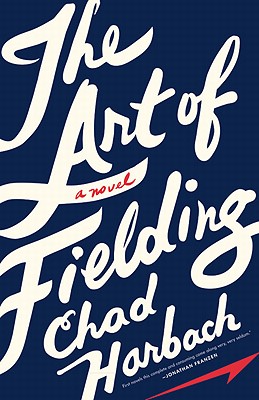
16. The Art of Fielding by Chad Harbach

I'd been dying to read this book ever since I first heard about it. A critically acclaimed novel about baseball? Awesome. A quick skimming of the reviews on Amazon showed that I liked it more than others, but that's often inevitable.

I wonder if someone who didn't love baseball -- love, not simply like -- could enjoy this book. I don't think they could. On the one hand, baseball is just a device in the novel, the backdrop for more human drama, but, on the other hand, Harbach's text is so deeply ingrained with a deep appreciation for America's pastime.

The main character, Henry, is a baseball phenom. His defense is impeccable, his love for the sport consuming. When things turn a little rotten for him, no one wonders if maybe he'd be ... in a better place if he had other things in his life besides baseball and his best friend, the catcher Mike Schwartz.

The book isn't without problems -- it's slightly unrealistic, and characters are often introduced and then forgotten. But I still really enjoyed it. It's not only an ode to baseball, but an ode to college life, where friendships can become consuming, girls are always walking around in miniskirted mobs, books change lives, bad days can turn into bad weeks and thinking about life post-graduation is an exercise in fear and self-loathing. It's wonderful and horrible, often at the same time.

There's the cliché that the time you spend in college should be the best years of your life, but most people, I think, would reject that idea. Mike Schwartz does: "Life was long, unless you died, and he didn't intend to spend the next sixty year talking about the last twenty-two."

The book also has a lot of meta stuff about literature and the way it affects us; the president of the university's life changed when as an undergrad he discovered an obscure lecture of Herman Melville, and he, his daughter and his lover spend a lot of time talking about books and the role of characters -- how sometimes we just view other people as characters in our stories as opposed to beings unto themselves. It reminds me of a line from The Elegance of the Hedgehog, to be honest. Common literary theme I guess.

Anyway, almost done with Nineteen Eighty-Four. Get pumped. Feminist Victoria is coming.

Wednesday, June 6, 2012

15. Saturday by Ian McEwan

I read this book hoping that it would get better, or, rather, that the sluggish pace of ordinary events would pick up. But, having finished the book a few hours ago and looking back, I enjoyed the long, lazing moments of the main character, the British neurosurgeon Henry Perowne, as he tries to have a wonderful Saturday. Things fall apart, in both little ways and small ones, and then things fall together again.

One of the more interesting facets of the book, for me at least, is the moment in time. It's London, February 2003, and the characters spend a lot of time discussing the prospects of the impending Iraq War. McEwan published the book in 2005, so he has some hindsight, but not as much as we do now, making it interesting just to see how conflicted the characters are about it. I suppose I found it even more interesting because I was so young at the time and thus locked out of the debate. I'm glad to know that it happened.

There was one moment where I felt kind of awesome: Henry's daughter Daisy is a poet, and at one point she read aloud one of her poems from her book. He describes it in a very hazy way -- he's a man of science and has spent a lot of time reflecting on how he doesn't "get" poetry. Anyway, in his hazy description, I thought to myself, "Wow that almost sounds like that one poem about the cliffs of Dover." Anyway, it turns out that she wasn't reading her own poem, but reciting the memorized "Dover Beach" by Matthew Arnold, the poem I'd been thinking of. It's worth a read, and McEwan includes it at the books end. It's fitting, because the book's themes reflect those of the poem -- the cruelty of the world, but the solace found in those you love.

All the quotes that adorned the front and back cover seemed to be about a different book thought -- it was an okay book, but not great. It was interesting, but not at all a page turner. I didn't exactly "need to know" how it ended, but I'm glad I stuck through the whole thing -- it gets better as it goes.

Next up: The Art of Fielding, which I'd started before I started this one, but my little brother wanted my mom's Kindle so he could read Catching Fire.

Saturday, May 26, 2012

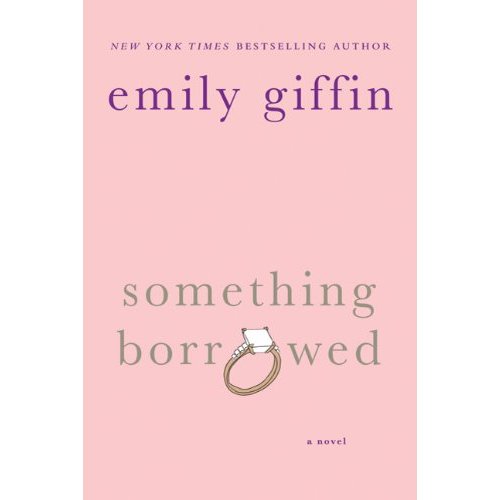
14. Something Borrowed by Emily Giffin

And on the other end of the literary spectrum, we have this piece of "chick lit" that turned into a bad movie with Kate Hudson, Ginnifer Goodwin and John Krasinski (Disclaimer: I haven't seen it, but it has a 15% on Rotten Tomatoes. We'll just leave it at that).

Anyway, so in this book the main character Rachel is super type-A and never takes chances or does bad things. This is emphasized repeatedly. On her 30th birthday, she sleeps with her best friend Darcy's fiance Dex, who she, Rachel, had met in law school. It turns into an affair, etc. etc.

There are quite a few things about this book that make it a bit implausible. First, Darcy is literally the worst human ever. Her best qualities include being pretty and telling stories that revolve around herself but amuse others. Rachel is only best friends with her because they've known each other since they were little, which is understandable, but it's never clear why Dex dates her, let alone thinks he ought to marry her. It makes the moral decision of the main characters too easy. If Darcy had even a single redeeming bone in her body, what they were doing would be more ambiguous and more interesting, but she's the worst. Griffin tries to make it seem like a tough decision, but it's really not.

The other highly implausible character is Rachel. She's supposed to be this super-smart, rich lawyer and a big law firm, but she never stands up for herself. I mean, I guess that's the point -- at the story's climax she tells Dex she has to pick and leaves him. But even then, it just seems unrealistic that someone so smart can be so dumb.

Anyway, I liked this book. I needed to know what happened, so I read it in a day (#nerdalert). Rachel talks a lot about her fear of being alone, a subject that hasn't been exactly ignored by popular media, but it was done in a refreshing way. Maybe that's why the book was so popular when it came out. Or maybe that's because it's kind of the ultimate awkward girl fantasy -- steal the hot guy who loves you for your brains, have a hot relationship, he leaves his hot fiance for you.

Or maybe we just like getting wrapped up in a world where dramatic, "true" (whatever that means) love happens somewhere between a law school library and your thirtieth birthday.

EDIT: I wanted to mention that Dex went to Georgetown. :)

Friday, May 25, 2012

13. Cloud Atlas by David Mitchell

This wasn't exactly the right book to start my speed-reading binge on, since, with 500 pages, it took all week. I honestly wasn't sure I liked it until I'd read almost 100 pages.

Here's the thing -- I had literally no idea what I was getting myself into. The back cover gives literally zero information about the plot. The novel tells six unrelated but inextricably linked stories, ranging from the early 20th century to a least a few hundred years from the present.

There's Adam Ewing, an American in the Pacific, fueled by imperialism and racial theories. There's Robert Frobisher (my favorite), the English composer with few morals or concerns. There's Luisa Rey, the journalist who finds the story of the century in an elevator, Timothy Cavendish, a book publisher with some strange luck and Sonmi-89, a clone struggling with the human condition. Last is Zachry, in the most brilliantly confusing story I've ever read. But Mitchell doesn't tell the six stories in order -- he starts each one, and then stops halfway through until he reaches Zachry's, which he tells in full. Then he picks up each story in reverse chronology, ending with Adam Ewing, the first.

In the book Mitchell says this structure might be "gimmicky," but it works wonderfully. As Ewing looks forward to the future at the end, full of hope and conviction, his words are tinged with the sadness of knowledge -- the rest of the book told us the future, and it sucks.

Yet, writing those words reminds me of a conversation in the first half of Luisa's story, where she discusses with a little boy the nature of knowing the future. They wonder if knowing the future necessarily changes it. Viewing the book in light of that conversation, maybe it's a little less sad.


I like quotes, so here's one from Cloud Atlas“My life amounts to no more than one drop in a limitless ocean. Yet what is any ocean, but a multitude of drops?” 


Preach.

Apparently the movie is coming out in December. That will be ... interesting. Lots of great actors are in it though, so I guess we'll see.

Also, gimme your book suggestions. Please and thank you.

Friday, May 11, 2012

12. Eating Animals by Jonathan Safran Foer

Since finals are finally finis (get it? I crack myself up), I can rededicate myself to this reading endeavor. My other New Years Resolutions were quickly forgotten, as they usually are, but this one I refuse to give up on.

Jonathan Safran Foer, husband of my favorite author Nicole Krauss, is known primarily for his fiction, but in this book he discusses the ethical implications of feeding his son meat.

In the book, he writes about how when people found out he was writing a book about eating animals they assumed he was writing a defense of vegetarianism. The same thing happened to me – everyone assumed that any book about eating animals could not come down in the practice's favor. I agree with him that this speaks volumes about the way we relate to omnivorism. People don't expect to hear good things about it, and Foer's book brings little good news.

I really enjoyed this book. Foer's skills as a novelist serve him well. He frames the story within his own life – his own memories of holidays and family dinners, his own concerns for his son. This keeps the book from getting too preachy.

But in the end, the picture is grim. Factory farming sucks guys. I'm not sure how you can read this book and still eat meat. Foer provides plenty of selfish and selfless reasons to stop: Surely one will hit you.

Read this book if you want to be challenged. Sorry, I feel like this is all coming off as slightly pretentious, but this is one of those books I want everyone to read so no one can plead ignorance. It's too important.


Wednesday, April 4, 2012

11. Olive Kitteridge by Elizabeth Strout

Well, it's been more than a month since I last updated. I should have finished this book during the two 18 hour car trips I took during Spring Break, but life happens. Somehow, if I read another book this week (which I plan to -- hey Easter Break), I'll only be two books behind my book a week schedule, which is pretty impressive.

So, this book, some of the ten that came before it, is also a collection of short stories that are all connected, in this case by the life of a grumpy schoolteacher, wife, and mother named Olive Kitteridge.

Olive sucks. She's judgmental and coarse. The only people she ever loves or even really likes are her husband and son, and she does a horrible job of showing that love to them.

But she's also impossibly strong, going through some pretty horrible things in her life but still persevering (sometimes against her own wishes). That paragraph is extremely vague to anyone who hasn't read the book, but I don't want to give it away.

One theme of the book is the connections Olive has forged with practically every member of her small New England community. But, it thankfully never gets into cheesy, It's a Wonderful Life-style schmaltz. Would everyone be better off without Olive? The question's never uttered aloud, but I can't help but wonder.

You really should go read this book. It doesn't take that long (says the girl who started it a month ago...), but it's splendidly written.

Next up: Still undecided on this one...

Thursday, March 1, 2012

10. The Elegance of the Hedgehog by Muriel Barbery

I'm almost a fifth of the way through! Look at me, actually sticking with my New Year's Resolution.

This book is one of the best from the first ten. It's about two women --the older Renee and the young Paloma -- who both live in a chic Parisian apartment building and are exceedingly intelligent and wildly unhappy. They spend a good part of the book waxing philosophic on art, life, and their disdain for the rich people they live with.

Both of them feel the need to suppress their brilliance for the sake of those around them, but eventually forge a friendship with one of the new neighbors, Monsieur Ozu that brings them both out of their shells.

The book isn't heavy on plot, and there are moments when it drags. But I really, really enjoyed this book.

Reading this book made me want to be a better person, but not in a cliché way. There was one part where one of the characters was talking about how people don't really talk to other people. The quote:
 "We don't recognize each other because other people have become our permanent mirrors. If we actually realized this, if we were able to become aware of the fact that we are only ever looking at ourselves in the other person, that we are alone in the wilderness, we would go crazy."
Truth. As someone who talks a lot, I sometimes wonder if I'm actually paying attention to the words coming out of the other person's mouth, or if I'm just waiting for them to be quiet so I can start talking again.

And the quote from which the book's title comes:

"Madame Michel has the elegance of the hedgehog: on the outside, she's covered in quills, a real fortress, but my gut feeling is that on the inside, she has the same simple refinement as the hedgehog: a deceptively indolent little creature, fiercely solitary -- and terribly elegant."
Isn't that just a marvelous metaphor for everyone in the world? Je pense que c'est vrai.

I also felt kind of cool for understanding Parisian cultural, social and political issues and short French phrases -- my French classes haven't been a total waste (I hope).

I feel like I haven't begun to do this book justice, but this will have to do. Read it yourself, because she says most things much better than I could hope to summarize them.

Next up: ...not exactly sure. Maybe Olive Kitteridge.


Sunday, February 19, 2012

9. Mockingjay by Suzanne Collins


Well, that was enjoyable.

I'm always hesitant about books that everybody is reading, because a lot of the time they're horrible (see Twilight). At the same time, that same "Everybody likes this so it's probably horrible" elitism almost kept me from reading The Girl With The Dragon Tattoo, so I'm glad I didn't let it stop me this time either.

Like I said Friday, these books are imperfect. They're too short. Some scenes are just seem rushed, and many of the character sketches are incomplete. At the same time it works on some level--Katniss is never really sure what's going on, and neither do we. It's a lot like real life: she doesn't understand her emotions, doesn't know what she wants, doesn't know what the right action is. She's a completely imperfect heroine.

I couldn't help but compare her to Harry Potter. For Harry, good and evil is an easy distinction, and, though Dumbledore becomes slightly more morally ambiguous in the last book, Harry never wavers in his faith that he's on the right side. Katniss never has this certainty. She knows the government is in the wrong, but she has reservations about the rebellion, ones she never really comes to terms with.

I suppose the difference between Harry and Katniss is that, with very few exceptions, Harry is always good, while Katniss can be kind of horrible (with good reason, though). It's refreshing, because heroes aren't perfect. We're not all Harry Potter.

The books aren't quotable or particularly eloquent. They get right into the dirt, the action of what's happening and Katniss's own confusing thoughts. But that's part of the reason why I could tear through them in three days--they're so fast-paced, I couldn't stop until I knew what happened. It's a good plot, and it will make a good movie (especially because so many things aren't explored. It leaves them a lot to explore).

Basically, read the Hunger Games trilogy if you like distopias, awesome female heroines, moral ambiguity, and/or have always wanted to be a skilled archer.

Next up: I don't know... I'll take a look at my bookshelf. Suggestions?

8. Catching Fire by Suzanne Collins


Well, I sped through this one too, finishing it pretty late last night, and then immediately downloading the next one, which I'm already immersed in.

Honestly, I'll just write something nice and long when I finish that one. Each book doesn't stand alone--it needs the others.

Next up: Mockingjay...